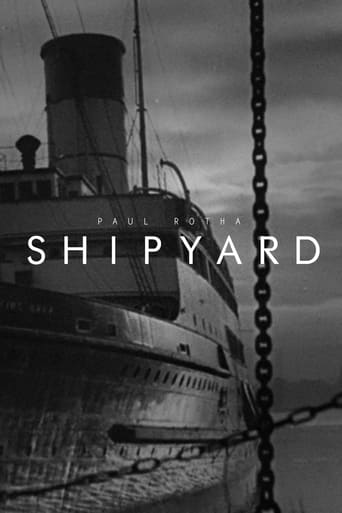
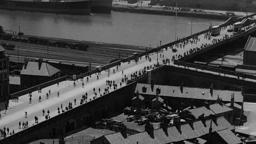
Ninety years after this documentary was made, Barrow-in-Furness is still home to the construction of the Royal Navy's nuclear submarines, but back in the days before the second world war it was a town of some 60,000 people. Many of them were responsible for the building of tens of thousands of tons
... of industrial and military shipping and this film shows us some of the panoply of skills involved in pressing, welding, hammering and moulding molten hot metal into the keel plates that form the basis of a manufacturing process that must have twenty jobs going on simultaneously if it has one - all supported by wooden scaffolding. There's a surprising lack of technological support here, so a considerable amount of their work is done manually and the attention to detail and inter-reliance of a team is well illustrated as a ship gradually emerges from, quite literally, the ashes. It's all precision engineering interestingly filmed across the cycle and taking the occasional break for some Sunday morning R&R (and dog racing) shows just how much work went into the crafting of this hull. There's a sparing narration to guide us along and provide the odd statistic, but for the most part the photography speaks for itself and it's really quite a fascinating demonstration of experts and synchronisation at work. I wonder what ever happened to number 697? It was to be a passenger liner - a 23,000 ton vessel called "Orion", that was launched by wireless from Sydney by HRH The Duke of Gloucester.